

Spray polyurethane foam has become one of the most popular ways to insulate and air seal homes, especially in attics, crawl spaces, and basements where traditional batts struggle. But "spray foam" is not a single product. The two main types, open-cell and closed-cell, behave very differently. They have different R-values, densities, moisture characteristics, and costs, and choosing the wrong one for a given spot can waste money or even create moisture problems.
This guide compares open-cell and closed-cell spray foam side by side, explains where each one belongs in a typical home, covers safety and re-occupancy during installation, and offers climate notes for homeowners in Tennessee and Florida.
What spray foam insulation is
Spray foam is created on site by mixing two liquid components, commonly called the A-side and B-side, at the tip of a spray gun. The chemical reaction causes the mixture to expand and cure into a solid foam that adheres to the surface it is sprayed on. Because it expands into gaps and cracks, spray foam can insulate and air seal in a single step, which is its biggest advantage over many other insulation types.
The difference between open-cell and closed-cell comes down to the structure of the tiny bubbles, or cells, inside the cured foam:
- Open-cell foam has cells that are intentionally broken, so air fills the spaces between them. The result is a soft, spongy, lightweight foam.
- Closed-cell foam has cells that stay intact and are filled with a blowing agent gas. The result is a dense, rigid foam that feels hard to the touch.
The U.S. Department of Energy's Energy Saver insulation guidance is a helpful neutral reference for how insulation types compare and why air sealing matters alongside R-value.
Open-cell vs closed-cell spray foam: side-by-side comparison
The table below summarizes typical characteristics. Exact values vary by manufacturer and product, so always check the specific product's technical data sheet.
| Property | Open-cell spray foam | Closed-cell spray foam |
|---|---|---|
| R-value per inch (approx.) | R-3.5 to R-3.8 | R-6 to R-7 |
| Density (approx.) | About 0.4–0.6 lb/ft³ | About 1.7–2.2 lb/ft³ |
| Feel and structure | Soft, flexible, spongy | Rigid, hard, adds some racking strength |
| Air barrier | Yes, at sufficient thickness (often around 3.5 in or more) | Yes, at about 1 in or more |
| Vapor permeability | Vapor permeable (allows drying) | Low permeability; typically a Class II vapor retarder at about 1.5–2 in |
| Water resistance | Absorbs water; not for wet or below-grade contact | Resists bulk water; commonly used below grade |
| Sound dampening | Good | Moderate |
| Expansion | Expands a lot; fills cavities quickly | Expands less; applied in thinner passes |
| Installed cost per board foot (approx.) | $0.45–$1.00 | $1.00–$2.00 |
Values are approximate and product-specific. A board foot is one square foot of foam one inch thick. Installed prices vary by region, project size, and access.
R-value, density, and air sealing explained
R-value per inch
Closed-cell foam delivers roughly twice the R-value per inch of open-cell foam. That matters most where space is limited, such as a 2x4 wall, a rim joist, or a shallow cathedral ceiling. In a roof assembly with deep rafters, open-cell can reach the target R-value simply by applying more thickness, usually at a lower total cost.
Density and strength
Closed-cell foam's higher density makes it rigid. Once cured, it can add some stiffness to walls and roof decks, and it stands up better to physical contact. Open-cell foam is light and flexible, which lets it move slightly with framing as a house expands and contracts.
Air sealing
Both types are effective air barriers when installed at adequate thickness. Air leakage often accounts for a large share of heating and cooling loss in older homes, so either foam can deliver comfort and energy benefits beyond what its R-value suggests. In practice, installation quality, meaning full coverage with no gaps at framing edges, matters as much as which foam you choose.
Vapor permeability and moisture control
This is where the two foams differ most, and where choosing correctly matters most.
Open-cell foam is vapor permeable. Water vapor can move through it slowly. That is useful because assemblies can dry, and roof leaks tend to show up on the interior rather than being hidden. The downside is that in colder climates, indoor moisture can pass through open-cell foam and condense on a cold roof deck or sheathing in winter, which is why some jurisdictions require a vapor retarder coating over open-cell foam in certain climate zones.
Closed-cell foam is a vapor retarder. At about 1.5 to 2 inches, many products qualify as a Class II vapor retarder. That makes closed-cell well suited to places where you want to limit moisture movement, such as basement walls, rim joists, and crawl spaces. The trade-off is reduced drying potential, so the overall wall or roof design must account for where moisture will go.
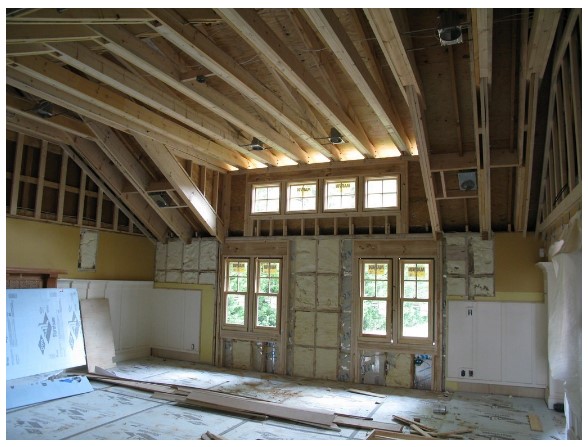
Where each type of spray foam belongs
Many projects use both types: closed-cell where moisture resistance or maximum R-value per inch is needed, and open-cell where large volumes need affordable insulation and air sealing.
Attic roofline (unvented attic)
Spraying foam to the underside of the roof deck creates an unvented, "conditioned" attic. This is popular in homes with ductwork or HVAC equipment in the attic because it brings those components inside the thermal envelope. Open-cell is common here in warm and mixed climates because deep rafters allow enough thickness at a lower cost. Closed-cell is used where rafters are shallow or where code or design calls for a vapor retarder. Building codes set specific requirements for unvented attics, so the design should follow local code.
Rim joists
The rim joist, where floor framing meets the foundation, is one of the leakiest spots in many homes. Closed-cell is usually the preferred choice because it air seals, adds high R-value in a small space, and resists moisture at a spot that often sees condensation.
Basement walls
For insulating concrete or block foundation walls from the inside, closed-cell is the standard choice. It tolerates occasional dampness, does not absorb water the way open-cell does, and limits vapor movement from the concrete into the living space. Open-cell is generally not recommended against below-grade concrete.
Crawl spaces
In an encapsulated crawl space, closed-cell foam is often applied to the foundation walls and rim joists, paired with a ground vapor barrier. Insulating the floor above a vented crawl space with open-cell foam is generally a poor idea in humid climates because it can absorb moisture. For details on the full approach, see our basement waterproofing and crawl space encapsulation service.
Metal buildings and pole barns
Metal panels are prone to condensation because they cool quickly. Closed-cell foam is the usual choice for metal buildings, shops, and barns because it bonds to the metal, acts as a vapor retarder, controls condensation drip, and adds some rigidity.
Interior walls and sound control
Open-cell foam absorbs sound reasonably well, making it a common choice for interior walls, home theaters, and floors between levels where thermal performance is less important.
Safety, ventilation, and re-occupancy during installation
Spray foam is safe once properly cured, but the installation process involves chemicals, including isocyanates, that can irritate the lungs, skin, and eyes and can cause sensitization in some people. Responsible installation includes:
- Vacating the work area. Occupants, including children and pets, should not be present during spraying. Many contractors ask households to leave the home entirely.
- Protective equipment for installers, typically including supplied-air respirators, full-body coverage, and gloves.
- Engineering controls such as containment and mechanical ventilation to exhaust vapors and bring in fresh air during and after spraying, with HVAC systems typically shut off or sealed off.
- A defined re-occupancy period. Manufacturers commonly recommend waiting at least 24 hours after spraying before re-entry, with some products or conditions calling for longer. Ask your installer for the specific product's re-occupancy guidance in writing.
- Thermal and ignition barriers. Building codes generally require spray foam in living spaces to be covered by a thermal barrier such as drywall, and foam in attics and crawl spaces to be protected by an ignition barrier or an approved coating, depending on how the space is used.
- Proper mixing and temperature control. Off-ratio foam or foam sprayed too thick in a single pass can cure poorly and cause lingering odors. Experienced installers follow manufacturer pass-thickness limits and substrate temperature ranges.
Climate zone notes for Tennessee and Florida
East Tennessee (climate zone 4)
Knoxville and much of East Tennessee fall in climate zone 4A, a mixed-humid climate with real heating and cooling seasons. That means moisture can drive in both directions depending on the time of year.
- Attic rooflines: Open-cell is widely used, but some designs in zone 4 add a vapor retarder coating over open-cell foam or use a closed-cell layer to reduce winter condensation risk at the roof deck. Follow local code and the manufacturer's guidance.
- Basements and crawl spaces: Closed-cell on foundation walls and rim joists is the typical approach, especially in the region's many homes with block foundations and clay soils that hold moisture.
- Humidity control: Encapsulated crawl spaces and conditioned attics often need dehumidification or conditioned air supply to keep humidity in check during humid summers.
Southwest Florida (climate zones 1–2)
Florida's peninsula lies in climate zones 1 and 2; the Port Charlotte area is in zone 2A, hot and humid. Cooling dominates, and outdoor air is often more humid than indoor air.
- Attic rooflines: Unvented attics with open-cell foam are common, and bringing attic ductwork inside the envelope can noticeably reduce cooling loads.
- Humidity management: Conditioned attics usually require some air supply or dehumidification to avoid elevated humidity at the roof deck.
- Termites and ground contact: Florida has strict rules about foam plastic in contact with the ground in termite-prone areas. Foam near slabs and foundations may require inspection gaps or specific treatments, so confirm requirements with your installer and local building department.
- Hurricane considerations: Closed-cell foam's adhesion to roof decks is sometimes cited as a benefit in high-wind regions, but it is not a substitute for code-required roof attachment.
Spray foam vs fiberglass and cellulose
Spray foam is not always the best answer. Fiberglass and cellulose remain cost-effective, proven options, especially for vented attic floors.
| Factor | Spray foam | Fiberglass batts or blown | Blown cellulose |
|---|---|---|---|
| R-value per inch (approx.) | R-3.5 to R-7 | R-2.2 to R-4.3 | R-3.2 to R-3.8 |
| Air sealing | Excellent | Minimal; needs separate air sealing | Some, when dense-packed |
| Relative cost | Highest | Lowest | Low to moderate |
| Best uses | Rooflines, rim joists, basements, crawl spaces, tight cavities | Open walls, vented attic floors | Vented attic floors, dense-pack wall retrofits |
| Moisture tolerance | Closed-cell high; open-cell low | Low when wet | Low; can settle when wet |
Comparisons are general and approximate; product performance and installed costs vary.
For a simple vented attic with no ductwork, air sealing the ceiling plane and adding blown cellulose or fiberglass often provides excellent value. Spray foam earns its higher price where air leakage is complex, space is tight, moisture resistance is needed, or you want to bring ducts inside the conditioned space. For more on where insulation pays off most, see our article on reasons to insulate your attic and basement.
Key takeaways
- Open-cell foam is lighter, less expensive, vapor permeable, and roughly R-3.5 to R-3.8 per inch.
- Closed-cell foam is dense, rigid, a vapor retarder at typical thicknesses, and roughly R-6 to R-7 per inch.
- Open-cell commonly suits attic rooflines and interior sound control; closed-cell suits rim joists, basement walls, crawl spaces, and metal buildings.
- Occupants should vacate during spraying and follow the manufacturer's re-occupancy time, often at least 24 hours.
- Climate matters: zone 4 Tennessee attics may need added vapor control, while Florida zones 1–2 focus on humidity and termite rules.
Choosing the right spray foam for your home
The best choice depends on where the foam is going, how much space you have, your climate, and your budget. A good installer will walk you through the moisture design of each area, not just the R-value, and will explain the safety plan and re-occupancy timeline before work begins.
Chippewacab installs open-cell and closed-cell spray foam for homes in the Knoxville area and around Port Charlotte. Learn more about our spray foam insulation services, or contact us for an assessment and a recommendation tailored to your attic, walls, basement, or crawl space.
Frequently asked questions
Closed-cell foam typically provides about R-6 to R-7 per inch, roughly double open-cell foam's approximate R-3.5 to R-3.8 per inch.
Open-cell foam is generally not recommended against below-grade concrete because it can absorb moisture. Closed-cell foam is the usual choice for basement walls and rim joists.
Manufacturers commonly recommend waiting at least 24 hours before re-entry, and some products or conditions call for longer. Ask your installer for the specific product's re-occupancy guidance.
It often is for rooflines, rim joists, crawl spaces, and tight cavities where air sealing and moisture control matter. For simple vented attic floors, air sealing plus blown cellulose or fiberglass can be the better value.
Need help with this? Our spray foam insulation team offers free on-site estimates in Knoxville, TN and Port Charlotte, FL. Request yours here.